
Good Teaching: A Provocation
(My New Book Is Out)

[Below is the preface I wrote for my new book, Good Teaching: A Provocation, available now from One Subject Press.]
It’s a commonplace observation but one that I’ll begin with anyway: The education system is not working for many, many young people. Though people working in American schools may disagree on a lot of different issues, most can agree on this one. But what I have struggled with throughout my career as an educator is how little the voices of teachers are included, much less heeded, in our local and national conversations about education and schooling.
So, I raised my own voice. I’ve written a book and started a publishing company which has a series dedicated to amplifying the voices of other teacher/writers. The Teacher / Writer series has a mission statement, which you can flip back to the very last page in this book to read.
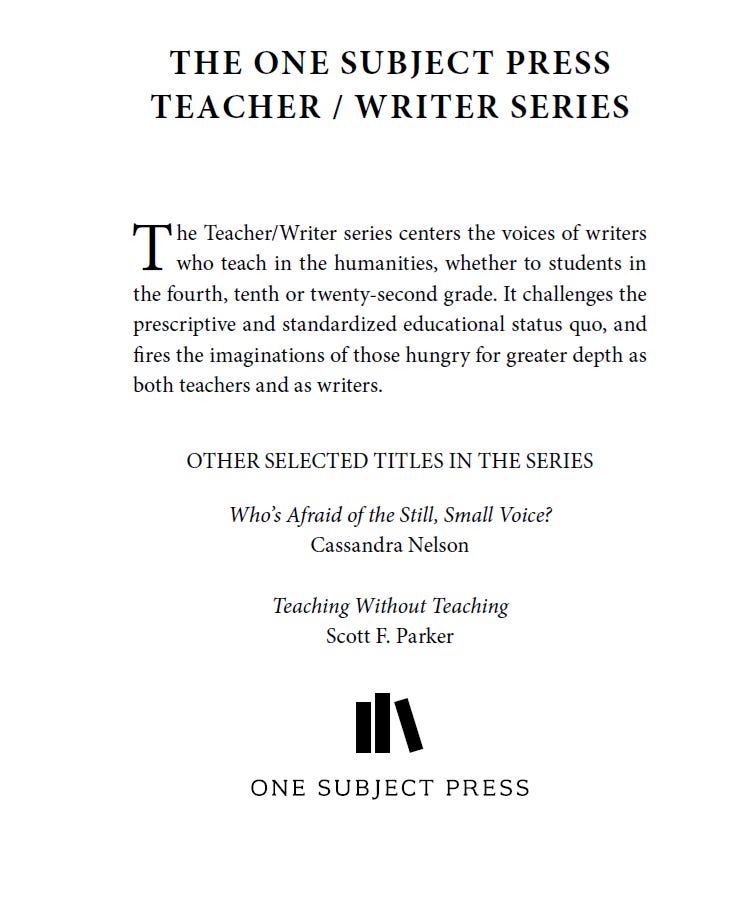
I did my best to distill in a few sentences what we, the teacher/writers in this (growing) series, hope to accomplish with our writing. If you, too, are “hungry for greater depth” in the ways we imagine teaching and learning, you have come to the right place.
At the same time, I have to admit that my own words as a writer tend to subvert and complicate things like goals, aims, and mission statements. My chief mentors in writing and in living have been poets and prophets, and sometimes those mentors have occupied the same vocation at once. The poets and prophets I have known are unimpressed by Strategic Initiatives or Five-Year Plans. They—we—are given words to say, to sing, to write. They—we—say them, sing them, write them. And then we go back to doing our daily work. For me, in 2026 at least, a good part of that is teaching.
If Good Teaching and the series it is a part of are doing their work, then these songs, sayings, and writings will help make clear to us teachers what are fruitful avenues for the work right now, what about the work is worth continuing in the future, and what can be left to die.
Administrators often ask teachers to justify their pedagogical decisions with data. Of course there is value to this request, this particular kind of scrutiny. They, the administrators, want to know we teachers are reading our exit tickets and that they actually affect our next lessons. They want to know that we are studying our end-of-unit surveys and that those surveys help improve our new and revised unit plans. They want to know that those standardized tests the students take year after year in subject after subject inform the ways we teach the skills of our courses. Okay. Fine. Fair enough. But the proposition of this book is that there are other data to consider, no less important, but much harder (maybe impossible) to quantify. To count.
I offer as an alternative to the quantitative data of surveys, exit tickets, and standardized tests the qualitative data of the oldest of human forms of communication, the story. I offer my own teaching and schooling life, in focused and hopefully meaningfully edited ways so that you, dear reader, may learn from it. This book, after all, is called Good Teaching, not Good Teacher. I make no claims about personal goodness in that regard (or any other), but I do claim that telling honest, heartfelt, and human-made (no AI-bots, please) stories about the art and craft of teaching will help inform new visions of teaching and schooling for the next generation.
I don’t make any claims for the eternal durability of these words. Why would I want to? As has happened a number of times over the two decades I’ve been a teacher, I have found myself in the writing of this book in a crisis over whether and how I want to continue to, as I put it in one of these chapters, “stay in the game” of teaching. My own way of coming to answers to a crisis of this kind is to tell stories, to consider where I’ve come from, to share the good, the bad, and the ugly of my profession, to write and share poems, and to connect with others facing the same forks in the road that I am. That is what I’ve attempted to do in the poems and essays that comprise this book. They are the ways I’ve tried to answer the “whether to” and the “how to” of staying a teacher in what I hope is a satisfying narrative arc. Because they are provisional answers woven together in a book, they will of course be particular and messy and time-bound. But they matter to me. And my belief, egotistical and stubborn though it may be, is that they will matter to many other readers, especially to other teachers. If you answer to that calling in any way, shape, or form, know that it’s for you that I wrote this book.
February, 2026
Saint Paul, Minnesota
NOTES:
-This is the sixth title I’ve published with our new publishing company, One Subject Press. The other five, each of which is a beauty (I know I’m biased), can also be found at our website:
Seven Last Words, a powerful reflection on the seven last words of Christ by Alice Camille;
Scapegoats, a terrific debut collection of short stories by April Vázquez;
From Glory to Glory: A Pilgrim’s Notes from the Badlands of Grace, a moving pilgrimage and memoir-in-essay form by Fr. Pat Hannon, CSC;
Fr. Joseph A. Brown’s magnificent theological reflection, A Retreat with Thea Bowman and Bede Abram (Second Edition);
Scott F. Parker’s Teaching without Teaching, a beautifully concise and provocative little book which kicked off the “Teacher/Writer” series that my own book is continuing.
May God make your words a light and guidance.
Well done Zac !!